


Related insights

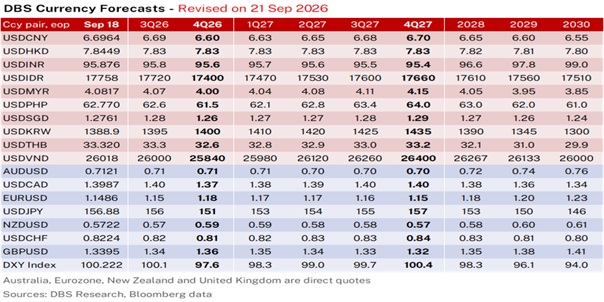
We have revised our FX forecasts.
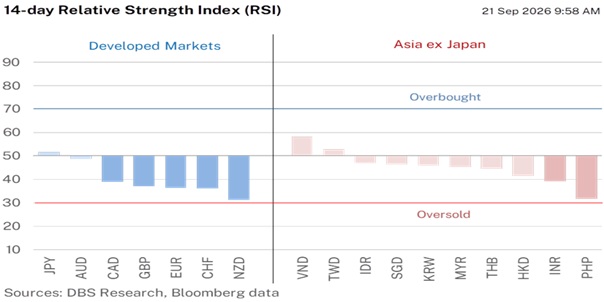
We do not see last week’s Fed rate hike triggering a structural breakout from the DXY Index’s post-Liberation Day trading range, which has been in place since mid-2025. Nor do we see the major central banks moving sufficiently apart to generate a sustained divergence in monetary policy.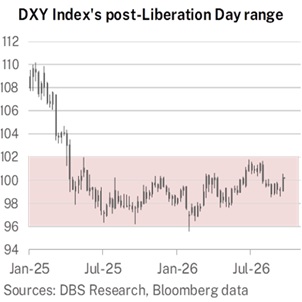
Market pricing reinforces this view. Further Fed hikes over the next 6-9 months are expected to be accompanied by tightening from the European Central Bank and the Bank of England. Rather than establishing a clean directional trend, major currencies are likely to remain choppy and range-bound, with tactical opportunities emerging as markets repeatedly reprice the timing and extent of central bank announcements.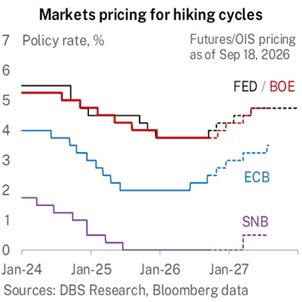
The unresolved standoff between US Treasury Secretary Scott Bessent and bond vigilantes is another reason to be cautious about extrapolating Fed hikes into sustained USD strength. Bessent’s expanded Treasury buybacks may provide periods of relief, but they do not resolve the forces pushing long-term bond yields higher. Investors are still seeking compensation for higher inflation and an elevated fiscal deficit.
The November 3 US midterm elections should have an important influence on the DXY Index, keeping it in the lower half of its 96-102 range. The polls show Democrats with a sizeable lead and a significant swing away from Republicans since 2024. A change in congressional control could challenge the US exceptionalism narrative that helped stabilize the USD following its post-Liberation Day sell-off. US President Donald Trump’s decision to revoke the press credentials of three media networks was likely intended to contain public scrutiny of the unpopular Iran conflict and associated energy-led rise in the cost of living.
There is, however, a counterargument against extrapolating election uncertainty into a one-sided USD decline. Greater political gridlock could constrain the Trump administration’s ability to push additional fiscal expansion and ease pressure on long-dated Treasury yields, while raising doubts about extending the conflict in Iran. Hence, the midterms could alter the balance of risks without necessarily breaking the broader range.
Asian currency highlights
We have lowered our 2026 floor for USD/CNY to 6.60 from 6.70 while retaining scope for further declines. The CNY remains Asia’s strongest currency this year, appreciating 4.3% YTD to a four-year high against the USD as of September 18. It currently has an appreciation bias into the September 24 Trump-Xi Summit in Washington and the October 8-9 EU-China meeting in Beijing.
However, the CNY’s monthly gains have slowed to 0.34% in September from 0.48% in August and 0.53% in July vs. two straight months of near-1% gains into the earlier Xi-Trump summit in May. Washington and Brussels are independently converging on China’s large external surplus, excess industrial capacity, and restricted market access. This leaves China facing a delicate balancing act. China will find it more difficult to rely on a weaker exchange rate as an escape valve for its domestic weakness. Making concessions to the US without addressing Europe’s complaints could lead Brussels to adopt tougher trade defences. Given that the Fed and the ECB have prioritised monetary tightening to return energy-led inflation to target, China has more incentive to keep the CNY relatively stable or allow measured appreciation.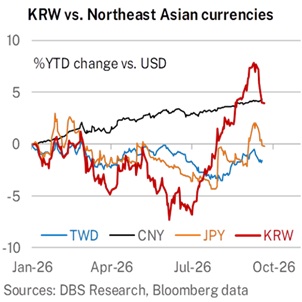
The KRW is likely to consolidate after moving rapidly from excessive pessimism in 1H26 to a sharp flow-driven recovery in 3026. The TWD’s experience in 2Q25 offers a useful parallel, i.e., the risk that corporates will convert or hedge accumulated USD holdings can fade quickly once expectations of one-sided appreciation subside. The recent burst of USD repatriation associated with a major Korean semiconductor company’s overseas listing is also unlikely to recur on the same scale. Meanwhile, the Bank of Korea’s hawkish outlook is partly offset by the Fed’s rate hike and market expectations for further tightening amid renewed volatility in global oil prices. Regional developments should become important too. The KRW’s rebound coincided with steady CNY appreciation and US-Japan efforts to arrest excessive JPY weakness. The KRW’s next phase is more likely to be consolidation and digestion of those gains than a continued surge.
Quote of the Day
“A well-adjusted person is one who makes the same mistake twice without getting nervous.”
Alexander Hamilton
Today in history
Britain abandoned the gold standard on September 21, 1931, devaluing the pound by roughly 20% to halt a massive drain on gold reserves during the Great Depression.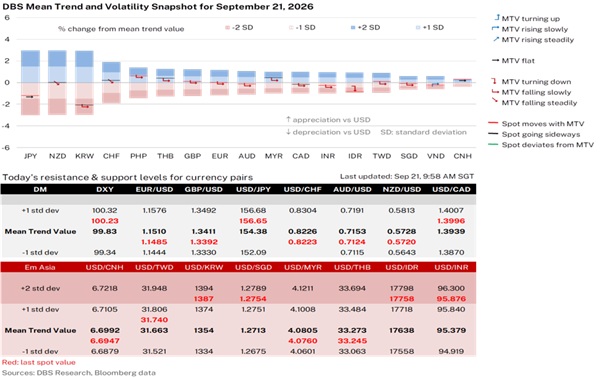

Topic
GENERAL DISCLOSURE/ DISCLAIMER (For Macroeconomics, Currencies, Interest Rates, Digital Assets or Commodities)[1]
The information herein is published by DBS Bank Ltd and/or DBS Bank (Hong Kong) Limited (each and/or collectively, the “Company”). It is based on information obtained from sources believed to be reliable, but the Company does not make any representation or warranty, express or implied, as to its accuracy, completeness, timeliness or correctness for any particular purpose. Opinions expressed are subject to change without notice. This research is prepared for general circulation. Any recommendation contained herein does not have regard to the specific investment objectives, financial situation and the particular needs of any specific addressee. The information herein is published for the information of addressees only and is not to be taken in substitution for the exercise of judgement by addressees, who should obtain separate legal or financial advice. The Company, or any of its related companies or any individuals connected with the group accepts no liability for any direct, special, indirect, consequential, incidental damages or any other loss or damages of any kind arising from any use of the information herein (including any error, omission or misstatement herein, negligent or otherwise) or further communication thereof, even if the Company or any other person has been advised of the possibility thereof. The information herein is not to be construed as an offer or a solicitation of an offer to buy or sell any securities, futures, options or other financial instruments or to provide any investment advice or services. The Company and its associates, their directors, officers and/or employees may have positions or other interests in, and may effect transactions in securities mentioned herein and may also perform or seek to perform broking, investment banking and other banking or financial services for these companies. The information herein is not directed to, or intended for distribution to or use by, any person or entity that is a citizen or resident of or located in any locality, state, country, or other jurisdiction (including but not limited to citizens or residents of the United States of America) where such distribution, publication, availability or use would be contrary to law or regulation. The information is not an offer to sell or the solicitation of an offer to buy any security in any jurisdiction (including but not limited to the United States of America) where such an offer or solicitation would be contrary to law or regulation.
[#for Distribution in Singapore] This report is distributed in Singapore by DBS Bank Ltd (Company Regn. No. 196800306E) which is Exempt Financial Advisers as defined in the Financial Advisers Act and regulated by the Monetary Authority of Singapore. DBS Bank Ltd may distribute reports produced by its respective foreign entities, affiliates or other foreign research houses pursuant to an arrangement under Regulation 32C of the Financial Advisers Regulations. Where the report is distributed in Singapore to a person who is not an Accredited Investor, Expert Investor or an Institutional Investor, DBS Bank Ltd accepts legal responsibility for the contents of the report to such persons only to the extent required by law. Singapore recipients should contact DBS Bank Ltd at 65-6878-8888 for matters arising from, or in connection with the report.
DBS Bank Ltd., 12 Marina Boulevard, Marina Bay Financial Centre Tower 3, Singapore 018982. Tel: 65-6878-8888. Company Registration No. 196800306E.
DBS Bank Ltd., Hong Kong Branch, a company incorporated in Singapore with limited liability. 18th Floor, The Center, 99 Queen’s Road Central, Central, Hong Kong SAR.
DBS Bank (Hong Kong) Limited, a company incorporated in Hong Kong with limited liability. 11th Floor, The Center, 99 Queen’s Road Central, Central, Hong Kong SAR.
[1] This disclaimer may not apply if the applicable assets fall within the definition of 'financial instruments' that are set out in Article 2(1) EU MAR (e.g. financial instruments that are traded on a regulated market, MTF or OTF, etc.). Section C of Annex I of MiFID2 specifies these 'financial instruments'.
Related insights
Related insights

- Member of Central Deposit Insurance Corporation (CDIC)